
The City of Swan runs a bin tagging education program to help improve resource recovery and waste management habits in the community.
Our bin taggers visit properties across the City and conduct a simple visual assessment of bin contents to check for contamination.
They’ll attach a tag to the bin’s handle with information on improving material separation.
Frequently asked questions
The City of Swan runs the bin tagging education program to help residents sort their waste correctly and reduce contamination in FOGO, recycling and general waste bins.
Sorting waste correctly helps us recover and recycle more materials. Food and garden waste can be turned into compost, while recyclable materials can be made into new products.
Putting the wrong items in a bin can contaminate the contents and make these materials harder to recover and recycle.
We randomly select a small number of properties (residential and commercial) in the City of Swan to have their bins assessed. These properties will be reviewed multiple times over six weeks.
Eventually, every property will participate in the bin tagging program.
We briefly check bin contents before collection to get a general overview of how waste is sorted at the property.
We do not search through bins or look for personal information. If we see items that do not belong in a bin, we may attach a tag to the bin handle with simple advice to help you sort your waste correctly.
We analyse the data we collect about bin contamination to help enhance our waste education programs so we can improve material sorting and resource recovery.
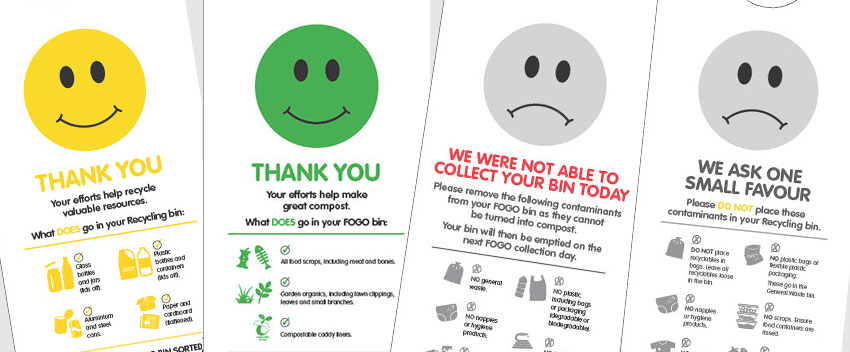
A happy face tag means you are sorting correctly and doing a great job.
A sad face tag that says "We ask one small favour" means you need to stop putting a specific item in that bin.
Sometimes you might get a "We were not able to collect your bin today" tag that means your bin was too contaminated for collection. You need to fix the issue before we can collect your bin.
Items that should never go in any bin
Hazardous waste
❌ Aerosols❌ Batteries (and anything that contains a battery)
❌ Chemicals
❌ Paint
❌ Electronic cigarettes
❌ Gas cylinders / Fire extinguishers
Learn more
E-waste
❌ Computers / keyboards, joysticks, cables❌ TV’s / cables
❌ Large appliances
❌ Phones (mobile phones, cordless phones, answering machines etc)
❌ Lighting and lamps (globes, tubes etc.)
❌ Medical devices
❌ Temperature exchange equipment
Learn more
Construction material
❌ Bricks❌ Rubble
❌ Soil
❌ Sand
Two-bin system
Recycling bin
| Accepted | Not accepted |
|---|---|
| ✔️ Cans (aluminium and steel) | ❌ Construction material |
| ✔️ Cardboard (flattened) | ❌ E-waste |
| ✔️ Glass bottles and jars (lids off) | ❌ Hazardous waste |
| ✔️ Paper (not shredded) | ❌ Long-life cartons |
| ✔️ Plastic bottles and containers (lids off) | ❌ Nappies and personal hygiene products |
| ❌ Soft plastics, meat trays, etc | |
| ❌ Takeaway cups and food packaging |
General waste bin
| Accepted | Not accepted |
|---|---|
| ✔️ Animal droppings and litter | ❌ Construction material |
| ✔️ Damaged clothing and textiles | ❌ E-waste |
| ✔️ Food scraps | ❌ Hazardous waste |
| ✔️ Garden organics (e.g. lawn clippings, prunings, weeds) | ❌ Medical waste such as syringes and needles |
| ✔️ Hygiene and sanitary products | |
| ✔️ Long life cartons (foil lined, UHT) | |
| ✔️ Meat trays | |
| ✔️ Nappies | |
| ✔️ Polystyrene (can be taken to a recycling centre) | |
| ✔️ Small plastic items (e.g. bread tags, plastic lids) | |
| ✔️ Soft plastics (e.g. zip lock bags, chip wrappers) | |
| ✔️ Takeaway cups and food packaging |
Three-bin system
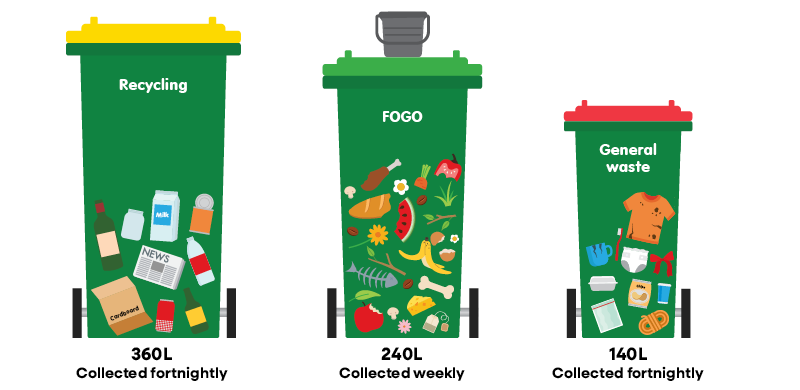
FOGO bin
| Accepted | Not accepted |
|---|---|
| ✔️ Coffee grounds | ❌Construction material |
| ✔️ Compostable liners (AS 4736) | ❌E-waste |
| ✔️ Food scraps | ❌ Glass or plastic |
| ✔️ Fruit and vegetables (including peels) | ❌ Hazardous waste |
| ✔️ Garden prunings (under 5cm in diameter) | ❌ Large branches or timber over 5cm in diameter |
| ✔️ Grass clippings | ❌ Nappies and personal hygiene products |
| ✔️ Leaves, weeds and flowers | ❌ Soft plastics, meat trays, etc |
| ✔️ Meat, bones, shells and seafood | ❌ Takeaway cups and food packaging |
| ❌ Treated wood |
Recycling bin
| Accepted | Not accepted |
|---|---|
| ✔️ Cans (aluminium and steel) | ❌ Construction material |
| ✔️ Cardboard (flattened) | ❌ E-waste |
| ✔️ Glass bottles and jars (lids off) | ❌ Hazardous waste |
| ✔️ Paper (not shredded) | ❌ Long-life cartons |
| ✔️ Plastic bottles and containers (lids off) | ❌ Nappies and personal hygiene products |
| ❌ Soft plastics, meat trays, etc | |
| ❌ Takeaway cups and food packaging |
General waste bin
| Accepted | Not accepted |
|---|---|
| ✔️ Damaged crockery, clothing, shoes and toys | ❌ Construction material |
| ✔️ Long-life cartons (foil-lined) | ❌ E-waste |
| ✔️ Nappies and personal hygiene products | ❌ Hazardous waste |
| ✔️ Soft plastics, meat trays, etc | ❌ Medical waste such as syringes and needles |
| ✔️ Takeaway cups and food packaging |
- City officers will tape your bin shut and tag it if it is contaminated or contains hazardous materials like batteries, nappies, aerosols, etc.). It won’t be collected until it is sorted correctly. We will list the contaminants on the tag attached to the bin handle. Residents need to remove these from the bin before the next collection day
- If it is continuously contaminated during the assessment period, we will tag it again and won’t collect your bin
- As a last resort – once multiple attempts have been made to give community members feedback about correcting their material separation – we will remove the contaminated bin from the property. Residents will need to contact the City to start the process of having their bin returned.
If you are struggling with sorting your materials, the Waste Education team is happy to support our community. Call us on (08) 9267 9267 to organise assistance.
When bin tagging is taking place in your area, it’s not unusual for collections to occur later than usual, sometimes as late as 3pm. This is because bin tagging must be completed before collections begin, and drivers may not follow their usual route. You’ll still need to place your bins out by 6am.