
We do not manage the control or removal of animal pests or invasive species, however we do work with a number of partners to support efforts.
Aside from their nasty bites, mosquitoes can be serious pests and transmit diseases.
The City of Swan maintains a thorough mosquito breeding and monitoring control program.
This includes:
- Routine monitoring of known salt marsh mosquito breeding sites
- Regular trapping of adult mosquitoes to gauge numbers
- Treatment of mosquito breeding on public land
- Enforcement of local laws in relation to breeding on private property
- Investigation of complaints about excessive breeding
- Follow-up questionnaires with residents who contract a mosquito-borne disease
- Health promotion activities.
Latest update – Mosquito issue in Guildford and South Guildford
The City is currently experiencing a significant increase in mosquito related complaints, particularly from South Guildford and surrounding areas.
Neighbouring councils, including City of Belmont, City of Bayswater, and Town of Bassendean, have reported similar trends, while the Department of Health has confirmed increased mosquito activity in the Cities of Perth, South Perth, Melville, and Canning.
The City of Swan operates an annual mosquito control program from September to May, depending on weather conditions. Despite our ongoing efforts, which include an increased application of larvicide compared to previous years, mosquito breeding continues due to various environmental factors.
The predominant species identified in traps is Aedes vigilax (the summer saltmarsh mosquito), an aggressive daytime biter capable of travelling several kilometres, especially under favourable wind conditions.
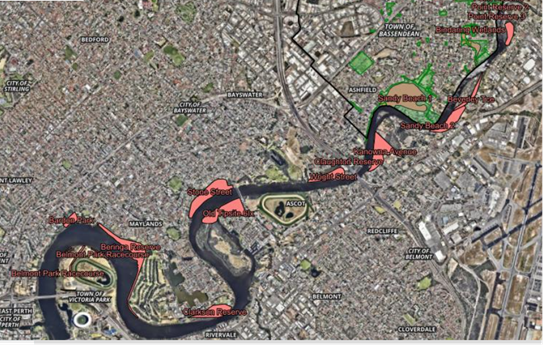
The map below depicts the more prevalent mosquito breeding locations along the Swan River which are routinely treated by the respective local governments in the East Swan River region.
Several environmental conditions beyond the City’s control have combined to create ideal mosquito breeding conditions:
- High tides - repeated high tides have extensively flooded saltmarsh areas, particularly along the river foreshore in Belmont and Bayswater, creating optimal breeding conditions
- Larvicide washout - frequent tidal inundation has diminished larvicide effectiveness by continually washing it away, necessitating repeated applications after each high tide
- Strong winds - recent winds have dispersed mosquitoes across a wider area, increasing their presence in affected suburbs
- Mild summer temperatures - until recently, lower-than-usual maximum temperatures have allowed adult mosquitoes to survive longer
- Lack of rainfall - reduced river inflows have resulted in more brackish water conditions, which Aedes vigilax prefers
- Daytime activity - unlike most mosquitoes that emerge around dusk, Aedes vigilax is active during the day, making the infestation more noticeable and disruptive to residents.
The City’s Health Services team continues to actively manage the situation in collaboration with neighbouring local governments. Our approach includes:
- Targeted larvicides to disrupt the mosquito lifecycle to reduce adult mosquito populations
- Ongoing monitoring of mosquito activity and environmental conditions to determine when additional larvicide treatments are necessary
- Resident engagement to provide guidance on reducing mosquito breeding around homes and preventing bites.
The City does not conduct fogging or spraying as part of our mosquito control program for the following reasons:
- The WA Department of Health does not endorse fogging in the metropolitan or southwest regions unless there is an imminent and significant disease risk. While mosquitoes can transmit Ross River virus and other diseases, such cases are relatively rare in the metropolitan area, classifying mosquitoes as a nuisance rather than a public health emergency
- Fogging is non-selective, killing beneficial insects
- Fogging and spraying are generally only effective while the solution is suspended in the air
- Windy conditions severely limit its impact
- Many of the chemicals used in fogging and spraying are highly toxic to aquatic life, making them unsuitable for use near the Swan and Helena Rivers the areas currently most affected.
Concerned residents can contact the City on 9267 9267 or submit an investigation request to Health Services either via the City’s website or swan@swan.wa.gov.au. There is further information available on steps that residents can take to reduce mosquito numbers around their residence and ways to prevent mosquito bites on the Healthy WA website - Prevent mosquito bites.
Stay safe and stay informed
As residents of the City of Swan, it is important to stay informed and keep up to date with mosquito-related news as it relates to the community.
Remember that containers around homes that collect rainwater or water from reticulation systems can become prime breeding grounds for mosquitoes. The species that thrive in these containers are known carriers of the Ross River Virus.
Additionally, many mosquito species breed in various water bodies, such as road drains, septic tanks, abandoned swimming pools, and saltmarshes. Some of these species can also transmit harmful the Ross River Virus.
It is crucial for everyone to take steps to minimise mosquito breeding to protect our health and lifestyle. Temperature, humidity and weather conditions play a large role in the quantity of mosquitos expected on any given day. For more information, City of Swan residents are encouraged to visit the AccuWeather mosquito forecast.
The City of Swan is a member of the East Swan River Contiguous Local Authority Group (CLAG), along with the Town of Bassendean, City of Bayswater, City of Belmont and the Town of Victoria Park.
Tips for residents
- Reduce outdoor activities during high-risk exposure periods such as dawn and dusk
- Cover yourself in long, colourful and loose-fitted clothing, particularly when outdoors
- Install and maintain fly screen doors and windows, keeping them closed where possible
- Apply an appropriate amount of insect repellent, particularly when outdoors
Fight the Bite’ mozzie campaign
The Fight the Bite campaign is an initiative led by Healthy WA that aims to reduce mosquito-borne diseases from affecting the community. The campaign highlights three key messages:
- Cover up
- Use repellent
- Clean up areas around the home where mosquitoes can breed.
For more information, visit: http://www.healthywa.wa.gov.au/fightthebite
If you are experiencing problems with mosquitoes contact us or submit an investigation request form.
We work with the Department of Primary Industries and Regional Development (DPIRD) to prevent the establishment of European wasps in WA. We set surveillance traps and when a European wasp is found, it is tracked back to its nest which is then destroyed by DPIRD.
Residents who have seen a European wasp can report it directly to DPIRD online, by using the MyPestGuideTM Reporter app or by contacting the Pest and Disease Information Service on +61 (0)8 9368 3080 or email padis@dpird.wa.gov.au.
Quite often Paper wasps are mistaken for European wasps. For a comparison, please refer to the Department's Wasp Identification Guide.
We maintain infrastructure, including weed/grass control in parks and drainage basins, that helps to reduce harbourage opportunity for rodents.
You can also help by limiting food and shelter available for these animals. If you want to rid your home of a rat or mouse, baiting and trapping are effective methods.
If after following this advice you still experience rodent problems please report the issue to us.

The science behind mosquito control
Did you know that it's only the female mosquito which bites? See how the City of Swan's Mosquito Control Program tackles the world's most deadly animal.
Polyphagous Shot-Hole Borer (PSHB)
Polyphagous Shot-Hole Borer (PSHB) (Euwallacea fornicatus) is an invasive beetle about the size of a sesame seed. It bores into trees and spreads a harmful fungus that can cause tree decline and death. PSHB can infest more than 500 species of trees and plants.
PSHB was first detected in East Fremantle in August 2021. A PSHB Quarantine Area now covers metropolitan Perth, including the City of Swan, to help slow its spread.
The City is working with the Department of Primary Industries and Regional Development (DPIRD) and neighbouring local governments to protect our trees and natural environment.
On June 18, 2025, the National Management Group determined that PSHB could not be eradicated because it is difficult to detect and control, and there is no effective chemical treatment.
The response now focuses on long-term management through:
- Surveillance
- Integrated pest management
- Managing affected trees
- Movement restrictions
- Research and technical support
- Community and industry education.
DPIRD focuses its pruning and tree removal program on trees that could spread PSHB beyond the Quarantine Area. Landowners and land managers are responsible for managing affected trees on their properties, with departmental guidance.
For current information, read the DPIRD Transition to Management frequently asked questions.
The WA Government has established quarantine restrictions covering the Perth metropolitan area, including the City of Swan, to help slow the spread of PSHB.
The PSHB Quarantine Area covers metropolitan Perth and has two zones:
- The Management Zone, where PSHB is more established
- The Containment Zone, covering outer metropolitan areas.
Movement restrictions apply to firewood, green waste, mulch, woody plant material and live plants. As the City of Swan spans both zones, check the current quarantine map before moving these materials.
Management Zone
You:
- Cannot move untreated or unseasoned wood outside the zone unless it is chipped to 2.5cm or smaller
- Cannot move live plants or plant material with stems or branches wider than 2cm outside the zone
- Must clean machinery and equipment before moving it outside the zone
- Can move wood and plant material within the zone.
Containment Zone
You:
- Cannot move untreated or unseasoned wood outside the Quarantine Area unless it is chipped to 2.5cm or smaller
- Cannot move live plants or plant material with stems or branches wider than 2cm outside the Quarantine Area
- Must clean machinery and equipment before moving it outside the Quarantine Area
- Can move wood and plant material within the Containment Zone or into the Management Zone.
Disposing of green waste
Green waste can be taken to an approved PSHB waste management facility. These include the City’s Bullsbrook and Malaga recycling centres and the Red Hill Waste Management Facility. Check opening hours, fees and disposal requirements before visiting.
When transporting green waste:
- Contain and cover the entire load
- Use a sealed trailer, truck or skip bin
- Clean your vehicle and equipment after use
- Follow all quarantine movement restrictions.
DPIRD's interactive PSHB Quarantine Area Map
DPIRD’s PSHB webpage
Female beetles are approximately 2mm long and range from brown to black. Only females can fly and spread to other trees. Males are smaller, approximately 1.6mm long, and do not have wings.
Mature larvae are approximately 3.5mm long. They are white, C-shaped and legless, with a reddish head.
Signs of a possible infestation include:
- Small, round entry or exit holes in trunks and branches
- Sawdust-like material, known as frass, around the holes
- Thick resin, sap or gumming
- Crystalline foam that may resemble small sugar volcanoes
- Dark staining around entry holes
- Wilting, discoloured or dying branches
- Canopy dieback.
If you notice any of these signs, leave the affected material where it is and report the tree by:
- Reporting it through the MyPestGuide Reporter app
- Calling the Exotic Plant Pest Hotline on 1800 084 881
- Contacting DPIRD’s Pest and Disease Information Service on (08) 9368 3080 or emailing padis@dpird.wa.gov.au.
PSHB does not travel far on its own but can spread through infested firewood, green waste, mulch and plant material.
Help slow its spread by:
- Following quarantine requirements
- Keeping wood and plant material within the permitted zone
- Covering loads during transport
- Using an approved green waste facility
- Checking trees and reporting suspected infestations to DPIRD
- Seeking advice before pruning or removing a tree you suspect is infested
- Cleaning equipment after use and disinfecting it with 70 per cent ethanol
- Buying mulch from reputable suppliers or using grass clippings or compost
- Choosing suitable native species when planting trees.
You can also subscribe to DPIRD’s monthly PSHB eNews for news and updates about the Transition to Management response.
Always follow the latest DPIRD advice when managing a suspected infestation or moving wood and plant material.