FOGO (Food Organics and Garden Organics) is being rolled out across the City of Swan as part of a standard three-bin kerbside collection waste service. The service collects food scraps and garden waste and processes the organic waste into compost instead of going to landfill.
As the largest local government by area in Perth's north-east, the City is rolling out the three-bin service in stages to help ensure the service works well for different property types and household needs.
From early 2026, households not yet on the system will be contacted to choose their bin sizes, with deliveries starting mid-2026.
Food organics
- Raw or cooked fruit and vegetables, including peels (please remove any stickers or wax)
- Raw or cooked dairy, meat and seafood scraps (including shells and bones)
- Bread, cereals, grains, pasta
- Coffee grounds
- Out-of-date food (unpackaged).
Garden organics
- Lawn clippings
- Garden pruning (under 5cm in diameter)
- Leaves and flowers
- Weeds (including seeding weeds)
- Straw or hay.
Caddy liners
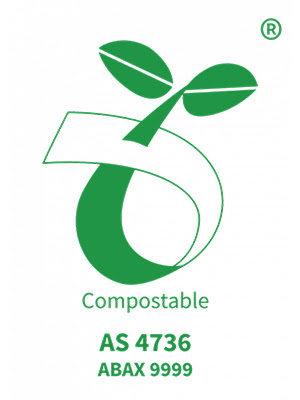
- Certified Australian Standard compostable caddy liners (look for the seedling logo AS 4736).
When in doubt, leave it out.
View a full A-Z list of what goes into which bin.
Prepare for FOGO: Practice your waste separation skills and try your hand at the Recycle Right sorting game.
Some plant or natural materials can be mistaken for going in the FOGO bin. These items won’t compost during FOGO processing and should be placed in the red-lid general waste bin, donated, or taken to one of the City’s recycling centres.
Do not put the following in your lime green-lid FOGO bin:
- Animal droppings (pet poo)
- All single-use cups (including compostable) – e.g. coffee cups/takeaway cups
- All food packaging (including compostable)
- Sand or soil.
- “Biodegradable” products like nappies, toothbrushes, feminine hygiene items
- Fruit stickers and wax
- Greaseproof baking paper, aluminium foil, “biodegradable” cling film
- Ash and barbecue charcoal
- Cane baskets, ropes, door mats, coir products, and coconut shells
- Rags, clothing, and textiles
- Terracotta pots and roof tiles
- Large amounts of fertiliser
- Cigarette butts
- Vacuum cleaner contents and dryer lint
- Cork, cellophane, cotton wool
- Leather goods, including shoes
- Building rubble such as bricks and concrete (take these to one of our recycling centres)
- Logs, timber, and branches over 5cm thick (take these to one of our recycling centres).
- Kitty litter.
When in doubt, leave it out.
View a full A-Z list of what goes into which bin.
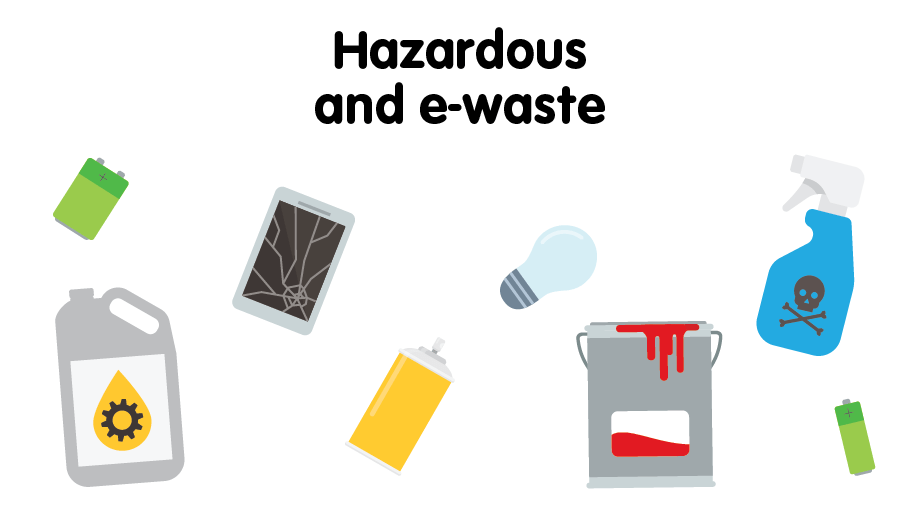
Remember that hazardous or electronic waste should never be placed in any of your kerbside bins. Please take them to a collection point or the City’s recycling centres.
Bin size changes for three-bin system households
As part of the FOGO rollout, the City will ask households for their preferred bin sizes.
If a household has already received the three-bin system and wants to make changes, residents can request modifications to their bin sizes by calling customer service on (08) 9267 9267 or emailing swan@swan.wa.gov.au
As part of the FOGO rollout, there is no additional charge for selecting a different sized bin at this time. Please note that the City reviews its fees annually as part of its budgeting process, and charges may change in the future.
I’m waiting for FOGO
The three-bin system will continue to be rolled out in stages from mid-2026 onwards.
When it is time for your area to join, households, businesses and strata managers will be contacted directly and invited to choose their preferred bin sizes. Please make sure your contact details with the City are up to date.
New bins will then be delivered so households can begin using the service.
The dates below are estimates only and may change.
| Stage | Season | Date of Stage | Suburbs |
|---|---|---|---|
| 1 | Winter 2024 | July-Sept 2024 | Ballajura, Cullacabardee |
| 2 | Spring 2024 | Oct-Dec 2024 | Bennett Springs, Beechboro, Kiara, Lockridge |
| 3 | Summer 2025 | Jan-Mar 2025 | Caversham, Dayton, Lockridge |
| 4 | Autumn 2026 | May-Aug 2026 | Bellevue, Bushmead, Guildford, Hazelmere, Koongamia, Midland, South Guildford, Woodbridge |
| 5 | Spring 2026 | Aug-Nov 2026 | Jane Brook, Middle Swan, Midland, Midvale, Stratton, Swan View, Viveash |
| 6 | Summer 2027 | Jan-Apr 2027 | Aveley, Ellenbrook, Lexia |
| 7 | Autumn 2027 | Apr- Jun 2027 | Aveley, Ellenbrook, The Vines |
| 8 | Winter 2027 | Jun-Sept 2027 | Brabham, Dayton, Henley Brook, West Swan |
| 9 | Spring 2027 | Sept-Dec 2027 | Aveley, Belhus, Bullsbrook, Ellenbrook, Melaleuca, The Vines, Upper Swan |
| 10 | Summer 2028 | Jan-Mar 2028 | Baskerville, Brigadoon, Herne Hill, Jane Brook, Middle Swan, Millendon, Red Hill, Upper Swan |
| 11 | Autumn 2028 | Mar 2028 | Malaga |
Choosing your bin size
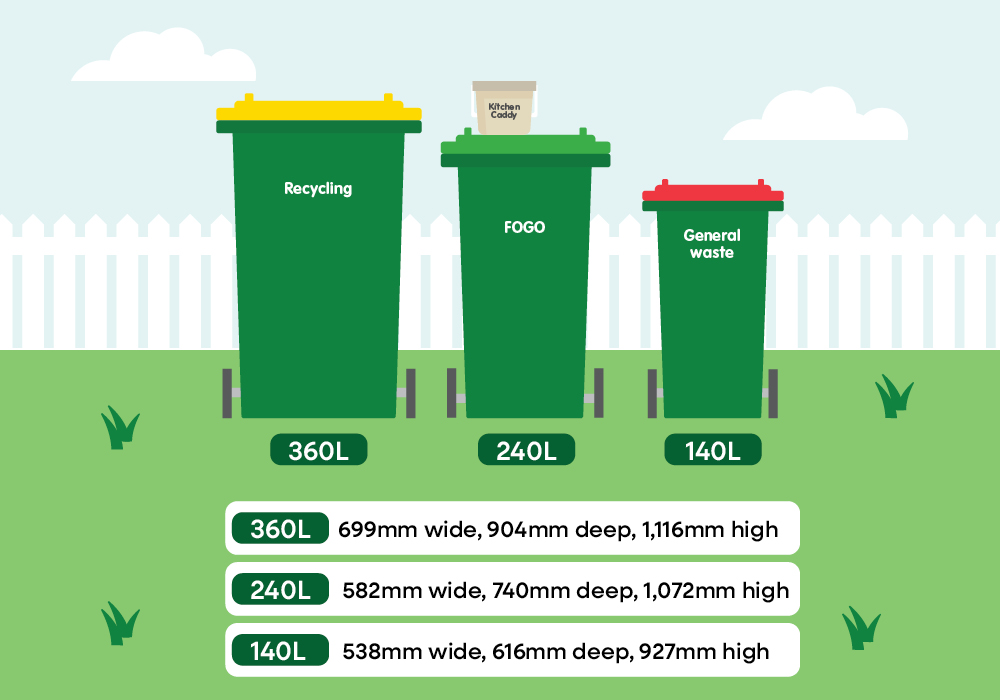
In the City of Swan, households can choose:
- 140L or 240L red-lid general waste bin
- 140L or 240L lime-green lid FOGO bin
- 240L or 360L yellow-lid recycling bin.
To help you decide, here are some examples of popular combinations:
- Small household or low-waste producers – 140L general waste, 140L FOGO, 240L recycling
- Standard service – 140L general waste, 240L FOGO, 360L recycling
- Large family with young children and a moderate/large-sized backyard – 240L general waste, 240L FOGO, 360L recycling.
If you do not request different bin sizes, the standard three-bin service will be delivered to your property. This includes a kitchen caddy, a 140L red-lid general waste bin, a 240L lime-green FOGO bin and a 360L yellow-lid recycling bin if you don’t already have one.
Frequently asked questions
Across Perth and Peel, waste audits show that most of what households put in red-lid general waste bins does not need to be there. On average:
- Around 50 per cent is food and garden waste
- About 17 per cent is recyclable
- Around seven per cent is hazardous or unsuitable for kerbside bins
- Only around 26 per cent is actual general waste.
This shows that a large portion of what currently goes into red-lid bins can be better managed through recycling and FOGO.
Diverting this organic material from landfill and processing it into compost helps us achieve a circular economy, reduce methane emissions and improve the quality of our soils.
Sending less waste to landfill also helps reduce disposal costs over time. This supports a more efficient waste service and helps manage long-term cost pressures for the City and the community.
Your new system will include a:
- Lime-green lid FOGO bin
- Red-lid general waste bin
- Yellow-lid recycling bin
- Kitchen caddy with two rolls of certified compostable liners.
Where apartments have shared storage compounds, the FOGO team will communicate with the strata manager to determine the best bin configuration for the complex.
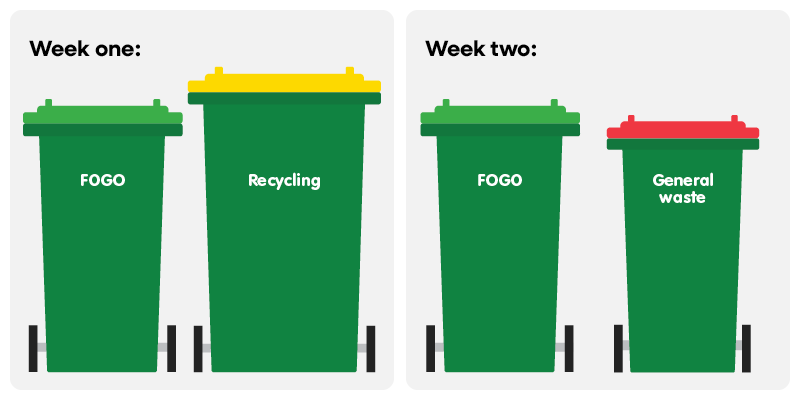
Once FOGO rolls out in your area, you will place two bins on your verge each week.
The lime-green lid FOGO bin will be collected weekly. The yellow-lid recycling bin and red-lid general waste bin will be collected on alternate fortnights.
FOGO waste is taken to a FOGO waste processing facility. The waste will be checked for contamination (items that don’t belong in the food and garden waste bin) and will go through a rigorous composting process. This process creates different grades of compost and mulch (made from larger garden-waste material).
From the facility, the compost and mulch can then be used across the City in farms, parks, gardens and land rehabilitation projects.
These items take longer to break down than the total FOGO composting process allows for. They are also lined with PFAS, a ‘forever’ chemical that repels oil and water, and helps insulate heat.
For more information on how to correctly sort your waste, visit recycleright.wa.gov.au.
You will receive a small kitchen caddy as part of the FOGO rollout when your lime-green lid FOGO bin is delivered. The caddy is used to collect food scraps in your kitchen before emptying them into your FOGO bin.
To help prevent smells, empty your caddy into your FOGO bin every few days or as needed.
If you prefer, you can collect meat scraps separately and store them in the freezer until bin collection day.
You will receive two rolls of compostable kitchen caddy liners with your new caddy. Each roll contains 75 liners.
Visit your local City of Swan library except Guildford, the City’s Administration Centre or the Recycling Centre – Malaga. Please bring valid ID showing your address.
You can also buy certified compostable liners from supermarkets.
Please note that biodegradable or recycled plastic bags are not compostable and should not be used in the FOGO caddy.
You can also use your kitchen caddy without a liner.
- Use compostable liners within 12 months of purchase or by their indicated expiry date
- Keep the liners in a cool, dark place
- When exposed to liquid, the liners will break down quicker. To avoid this, replace the liners every two to three days.
The liners can break if overfilled. Try to change the liners before the bag is full to avoid this from occurring. You can also carry the kitchen caddy to the bin and empty the tied bag straight into the lime-green lid FOGO bin.
You can reduce odours in between collections by:
- Emptying your kitchen caddy every few days
- Keeping your kitchen caddy clean (it is dishwasher safe)
- Keep food scraps that tend to smell, such as fish bones, in the freezer until the night before bin collection
- Sprinkle bi-carb soda on top of food waste
- Using compostable kitchen caddy liners
- Adding dry materials such as leaves to the bottom of your FOGO bin
- Storing your FOGO bin in a cool, shady spot with the lid closed where possible
- Washing your bins occasionally with vinegar and water
- Put your bin out for collection every time, even if it isn’t full.
If your red-lid general waste bin contains nappies, sanitary products or medical waste, odours can be reduced by:
- Where possible, emptying nappy contents into the toilet before wrapping the nappy into itself and then tightly into a nappy sack or bag to contain the odour
- Wrapping waste in newspaper or used food packaging, such as bread bags
- Using reusable sanitary products or cloth nappies where suitable.
To help prevent flies and pests:
- Tie rubbish bags tightly
- Keep bin lids closed
- Rinse bins regularly in warmer months
- Use natural cleaning products or repellents such as eucalyptus or tea tree oil if needed.
Nappies cannot go in the FOGO bin because human waste cannot be processed into compost.
To help reduce smells from used nappies:
- Empty nappy contents into the toilet before placing the nappy in the bin
- Wrap nappies in a nappy bag or reuse food packaging such as bread bags
- Store your red-lid bin in the shade where possible
- Tie rubbish bags tightly
- Rinse your bin occasionally, especially in warmer months.
If your bin is cracked or damaged, please contact the City for repair or replacement.
Any food you do not currently compost (such as meat, seafood, bones, citrus, dairy products) can go in your FOGO bin, so you can further reduce the amount of food waste sent to landfill.

Want to speak with the FOGO team?
Come and chat with us at:
Ballajura Fair
Ballajura Community College Oval
Sunday, October 18, 2026, 10am–3.30pm